







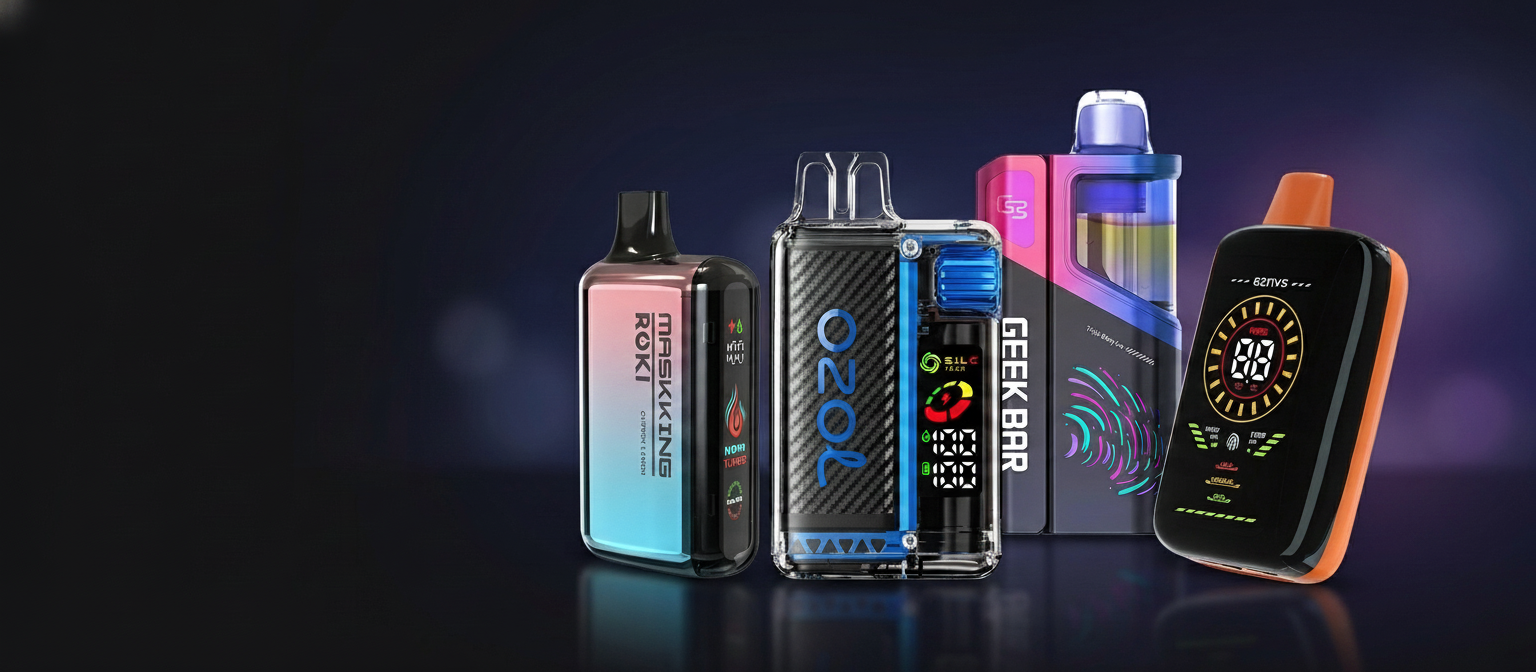
Your forwarder quotes $0.38 per unit. Door to door, 25 days, DDP. Four weeks later the container is sitting in Rotterdam and you are looking at a storage invoice, a request for a packaging conformity report you have never heard of, and a discharge record for the battery packs that nobody mentioned when you booked.
That gap between the quote and the invoice is where most of the money in this trade quietly disappears.
This guide is for importers, distributors and shop owners buying vapes by the pallet or the container. It covers what actually changed in 2026, what has to be in the shipping file, how the duty math works, and the failure points that show up on vape shipments again and again. It is written from the manufacturing side of the trade, because that is where the paperwork is created long before anything reaches a port.
Two housekeeping notes. This is not legal advice and not customs advice. Every market has its own rules and they move, so verify anything here against the current regulations and a licensed broker in your destination country. And everything below assumes you are selling to adults, through licensed channels, in a place where your product is legal to sell. If that last part is not true, no shipping strategy will save you.

Why 2026 Is a Different Year for Vape Freight
Four things changed, and together they rewrote the risk picture.
UN38.3 Revision 8 became mandatory. Since 1 January 2026, lithium batteries moving internationally have to be tested against the eighth revision of UN38.3. Reports issued under Rev.6 or Rev.7 are no longer accepted by airlines, shipping lines or customs. If your factory is still attaching a 2023 report to the shipment folder, the box does not move. This is the most common reason a vape shipment dies at origin right now, and it usually surfaces about four days before the vessel is due to sail.
The US moved from “hold” to “destroy.” The FY2026 Agriculture Appropriations bill gave federal authorities the power to seize and destroy unauthorised vape shipments at the border immediately, rather than holding them while a legal review works through. For an importer, that changes the downside from “delayed six weeks” to “gone,” with no recovery path. FDA had authorised only a few dozen ENDS products by mid-2026 and no flavoured disposables at all, so the practical exposure in that category is not small.
The EU tightened packaging checks at the border. From 1 July 2026, e-cigarette products entering the EU need child-resistant packaging certified to ISO 8317:2023, with a verification report issued by an EU-recognised Notified Body. Then on 12 July 2026, EUROCUSTOMS launched Special Inspection Action 2026/1, which checks specifically that the packaging report contains retest data after at least three temperature and humidity cycles (40°C / 90% RH down to 23°C / 50% RH) plus drop-retest results. Enforcement began at major German, Dutch and Belgian ports. Shipments without complete retest records face refusal of entry or return to sender, and the return freight is yours to pay.
The UK added a duty. Disposable vapes have been off the shelves since 1 June 2025. From 1 October 2026 the Vaping Products Duty applies, which drags more tax compliance into the customs file and adds a stamping and reporting layer that wholesalers have to build into their picking process.
Look at the pattern in all four. Freight stopped being a price question and became a documentation question. Operators who understood that early are clearing in 48 hours. Everyone else is paying storage.
Air Freight or Sea Freight? The Honest Comparison
Short answer: sea, almost always. Air exists for samples and emergencies, and even then it comes with restrictions that make it a very different product from the one your forwarder described.
| Mode | Typical door-to-door transit | Cost profile | What constrains it | Use it for |
|---|---|---|---|---|
| Express courier (DHL, FedEx, UPS) | 3–7 days | Highest per kilo | All three prohibit vaping products across their networks | Nothing vape-related |
| Air freight | 5–10 days | Battery surcharges add roughly 35–60% on top of a standard rate | 30% state-of-charge cap on loose cells and batteries packed with equipment; dangerous goods handling; limited carrier acceptance for e-cigarettes | Samples and urgent small restocks |
| Sea LCL (groupage) | 25–40 days | Mid | Dangerous goods booking required; in groupage, one mislabelled carton can hold the whole container | Two to eight pallets |
| Sea FCL (20GP / 40HQ) | 25–40 days | Lowest per kilo, roughly 60–80% under air | Full dangerous goods container booking; battery slots on vessels are limited and go early | 500+ cartons, and any real volume |
Air freight is not simply the expensive option. It is structurally restricted. Loose lithium-ion cells cannot fly on passenger aircraft as cargo at all, and the state-of-charge cap means rechargeable product often has to be discharged to 30% before a carrier will accept it. Then there is the forwarder layer. Plenty of them will take your booking and quietly hand it to a channel that treats dangerous goods as an afterthought. When that shipment gets flagged, nobody picks up the phone.
On a 40HQ of disposables, the air-versus-sea argument is rarely worth having. You are talking about roughly doubling your per-kilo cost to save three weeks. If a three-week delay kills the deal, the deal has a cash-flow problem, not a logistics problem.
Where air does earn its money: samples, a hot SKU that sold out before the sea shipment landed, and trade shows. Budget for it as an expense line, not a shipping lane.
One exercise worth doing before every booking. Work out what a single day of delay costs you. Warehousing, interest on the inventory, the retail value of an empty shelf, and the chance that a competitor gets the flavour first. For most importers that lands somewhere between $40 and $150 a day. Against that number, three weeks of air premium almost never pays back on volume. On 200 units it sometimes does. Run the arithmetic instead of guessing.
The Document Pack: What Has to Be in the Folder
This is the part that decides whether your money comes back. Everything here gets prepared at the factory, weeks before the vessel sails, and a missing page cannot be fixed at the port.
UN38.3 Rev.8 test report
Eight tests: altitude simulation, thermal cycling, vibration, shock, external short circuit, impact and crush, overcharge, forced discharge. The test criteria come from the UN Manual of Tests and Criteria, and on the air side they are enforced through IATA’s Dangerous Goods Regulations, which are reissued every year and always worth checking against the version your forwarder is quoting. The report itself has to come from a laboratory with CNAS or A2LA accreditation, and it should carry the original test data, photographs and curves so it can be traced. Typical cost runs $2,000 to $5,000 per cell model, and typically takes two to four weeks.
Three details that cause most of the trouble. First, a report on a cell does not cover the assembled pack. The pack is a separate product and needs its own coverage, usually a partial retest of the vibration, shock and short-circuit items. Second, reports are model-specific. Change the capacity, the voltage by more than about 20%, the protection board, or the cell supplier, and you are back in the queue. Third, check that the model number on the report matches the device in your box. Reused and mismatched reports are common enough that forwarders now spot-check them, and a report tied to the wrong model is worth exactly nothing at the port.
Where to look first: open the report, find the model designation, and compare it to the model designation on the device, the box and the SDS. If those four do not agree character for character, stop the shipment. This single check prevents more seizures than any other.
MSDS / SDS
GHS format, with the UN number, the watt-hour rating, the cell chemistry and transport information. The model number, Wh rating and UN number in the SDS must match the physical goods and the UN38.3 report. When customs finds a mismatch, the working assumption is not “typo,” it is “forged document,” and that conversation goes badly.
Air transport condition appraisal and dangerous goods packing certificate
If you are moving anything by air, the UN38.3 report is only the foundation. You also need the air transport condition appraisal, normally issued through a recognised body such as the Shanghai Chemical Research Institute or DGM, and it is usually valid only to 31 December of the year it was issued. Reapply annually or you will discover the problem in January. For sea dangerous goods bookings, you need the packaging performance certificate for the export packaging, plus UN-specification cartons that prevent short circuit and compression.
Commercial documents
Commercial invoice, packing list, certificate of origin if you want preferential rates, and the booking confirmation. One check that matters more than the rest: the goods description on the invoice. “Electronic atomizer parts” or “plastic goods” is an invitation to inspect. “Disposable electronic cigarettes, nicotine 20 mg/mL, 2 mL, HTS 2404.12.1010” walks through. A distributor in Manchester once showed me a seizure notice for 400 cartons where everything was in order except the invoice description. Four words took down the whole shipment.
Market-entry documents by destination
- EU: TPD notification reference for the product, child-resistant packaging certificate to ISO 8317:2023 with the Notified Body report, EU Track & Trace registration, and the importer’s EORI number.
- UK: MHRA notification, correct UK labelling and warnings, and from 1 October 2026 the duty registration and stamping arrangements.
- US: PMTA status documentation, ATF registration for PACT Act purposes, and any applicable state licence or directory listing.
- Canada: child-resistant packaging to the federal requirements plus bilingual health warnings.
One honest caveat. No document pack makes an unauthorised product legal. It only decides whether your money is released or destroyed. Those are different problems and it is worth keeping them separate in your head.
HS Codes, Duty, and the Number People Still Get Wrong
The 2026 US tariff schedule broke disposable vapes out at the ten-digit level, which ended a long-running argument about classification. The current line and rate are published in the Harmonized Tariff Schedule maintained by the US International Trade Commission, and it is worth opening that page yourself rather than trusting a code that was copied from a supplier’s invoice. Heading 2404 covers products intended for inhalation without combustion. 2404.11.00 is the line for products containing tobacco or reconstituted tobacco, at 24.7 cents per kilo. The nicotine-containing disposables sit inside 2404.12, and the statistical breakouts actually named “Disposable electronic cigarettes (e-cigarettes) and similar disposable personal electronic vaporizing devices containing nicotine” appear at 2404.12.05.10 and 2404.12.10.10, with a parallel pair under 2404.19 for nicotine-free product.
The old habit of filing these under 8543.70 as electrical apparatus survives in a lot of broker templates. It is also a reliable way to get a ruling issued against you.
Rates on the 2404.12 lines are a mix of specific and ad valorem components, and for Chinese-origin goods the Section 301 measures and the 2026 reciprocal surcharges stack on top. That is why the honest answer to “what will I pay?” is “ask your broker for the entry summary, not the tariff line.” Any figure quoted to you without that qualifier is a guess.
On the EU side, heading 2404 applies across the union, and the applicable duty rate for your origin country is published in TARIC. Expect MFN duty on the 2404 11 lines in the mid-teens as a percentage, plus import VAT at the destination rate, plus national excise where it exists. Germany raised e-liquid excise to €0.32 per millilitre in January 2026, and several member states now run their own duty regimes on top of TPD compliance. EU Track & Trace registration is required before the product can be placed on the market, and that registration is an importer-side obligation.
So the rule is simple and unglamorous. Get the ten-digit code right, print it on the invoice, and hire a broker who has cleared vaping products before. A broker who has never done a 2404 entry will learn on your shipment, and you will pay for the lesson in storage.
Why Customs Holds Happen, and How to Make Them 48 Hours Instead of Three Weeks
Almost every hold comes down to a mismatch. The UN number on the label does not match the declaration. The model in the SDS does not match the model in the box. The declared value does not match the price on the same product in the buyer’s own web shop. Officers are not looking for reasons to stop you. They are matching four documents against each other, and the documents disagree.
Vague descriptions are the second cause. Under-declared value is the third, and it is the expensive one. Cutting declared value to reduce duty is the most costly saving available in this business, because when it is found you get the reassessment, the penalty and the inspection history all at once, on every future shipment through that port.
In the EU right now, the specific choke point is the child-resistant packaging file. Customs at German, Dutch and Belgian ports are checking for the three-cycle retest and the drop retest, not just the existence of a certificate. Manufacturers who hold a general packaging conformity document but not the retest sequence are getting stopped, and so are the importers who bought from them.
The drill that keeps holds short is boring and works. Send the complete file to your broker 72 hours before vessel arrival. Pre-clear where your broker offers it. Keep one folder per shipment containing the declaration, the test report, the SDS, the invoice and the packing list, and keep the entry number in it. When the file is complete, holds usually release inside 48 hours. The three-week holds are almost always a document that does not exist rather than a question that has not been answered.
DDP Sounds Clean Until You Ask Who the Importer of Record Is
DDP means the forwarder clears the goods in their own name and hands them to you at the door. For a compliant consumer product moving into a market with no product-specific licensing, it works. Vaping products are not that, in most of the markets you care about.
The problem is structural. In the US, the importer of record for PACT-regulated tobacco products carries registration and reporting obligations that a general freight forwarder cannot assume. In the EU, TPD notification and Track & Trace registration sit with the manufacturer or importer, not with the carrier. In the UK, the same logic applies to MHRA notification and, from October 2026, the duty. So when a forwarder quotes you “DDP” into one of those markets, ask what they actually mean, because the legal answer is often that DDP is not available for this category at all.
I have watched three separate buyers this year discover that their DDP quote was really DDU with better marketing, and the discovery arrived as a duty invoice.
Three questions to ask before you book:
- Whose name is on the customs entry as importer of record?
- Will I receive the customs declaration and the duty receipt after clearance?
- If the entry is rejected, who owns the loss and who pays the return freight?
If the answers are vague, you are not buying DDP. You are buying optimism, and you are holding the risk.
Where You Can Actually Land Product in 2026
This changes fast enough that any list dates within a quarter, so treat the table as a starting point for your own check rather than a final answer. The two sources worth bookmarking are the FDA’s tobacco products pages for anything US-bound and the European Commission’s e-cigarette pages for the EU, because both publish the underlying rules rather than a summary of them.
| Market | Practical status in 2026 | What usually stops importers |
|---|---|---|
| United States | Legal path exists but is narrow. FDA authorisation required; only a few dozen ENDS products authorised by mid-2026 and no flavoured disposables | PMTA status, state directory listings (California, Florida, North Carolina, Tennessee, Virginia, Wisconsin and others), state flavour bans, federal seize-and-destroy at the border |
| United Kingdom | Single-use vapes banned from sale since 1 June 2025; rechargeable and refillable systems remain legal. Vaping Products Duty from 1 October 2026 | Building a range around the wrong product format, and duty registration arriving late |
| European Union | TPD caps unchanged at 20 mg/mL nicotine, 2 mL disposable and cartridge volume, 10 mL refill bottle. Belgium (Jan 2025) and France (Feb 2025) banned single-use devices nationally | The ISO 8317:2023 packaging file, TPD notification, Track & Trace, and national flavour rules in the Netherlands and Denmark |
| Australia | Retail import is closed. Pharmacy-only therapeutic channel | Everything. There is no compliant commercial route in |
| New Zealand | Disposable vapes banned since 17 June 2025 | Product format, same as the UK |
| Canada | Federally open with child-resistant packaging and bilingual warnings required | Provincial flavour restrictions that differ province to province |
Read that table as a product-planning document, not a verdict on the industry. The category that is dying in one market is often growing in another, and the difference between a good year and a bad one is whether you built the SKU map before or after you built the purchase order. That mapping exercise is the real edge in 2026, and it costs nothing but an afternoon of reading.
Keep the TPD revision timeline in view too. The European Commission’s public consultation closed on 14 August 2026, and the earliest realistic adoption is 2028 with member states taking a further two years to transpose. No blanket EU flavour ban is on the table and no EU-wide disposable ban has been proposed. What is coming is more harmonised rules on flavours, refillability and recyclability, which means packaging that has to be reworked across multiple markets at short notice. Choose manufacturing partners who can change a carton quickly, or you will be the last one in the market with a compliant SKU.
Samples: The Cheapest Place to Lose $900
Sample shipments get seized out of proportion to their value. The reason is paperwork. A 200-unit sample order often gets shipped with a doctored invoice or a description like “gift,” because the sender assumes nobody looks. Customs looks, and now there is a record attached to your name at that port.
Send samples legally, through a channel that actually accepts e-cigarettes, with the full file, even though it costs more. If you cannot get a legal sample shipment through, that is your answer about the container. Better to find out at $900 than at $90,000.
A Worked Landed-Cost Example
Numbers make this concrete. The figures below are illustrative and not a quote, but the structure is what matters.
Say it is 12,000 units of a 40,000-puff rechargeable disposable, sold FOB Shenzhen at $6.10 and landed in Rotterdam.
| Line | Amount | Per unit |
|---|---|---|
| Goods, FOB Shenzhen (12,000 × $6.10) | $73,200 | $6.10 |
| Origin charges, export documentation, dangerous goods packaging certificate handling | $420 | $0.04 |
| Ocean freight, 40HQ Shenzhen to Rotterdam, including dangerous goods surcharge | $3,900 | $0.33 |
| Marine insurance (0.35% of CIF) | $272 | $0.02 |
| EU import duty at 16.6% of CIF | $12,913 | $1.08 |
| Destination terminal handling, clearance and drayage | $780 | $0.07 |
| Compliance amortised: TPD notification, ISO 8317:2023 packaging report, Track & Trace | $900 | $0.08 |
| Port storage while the packaging report was chased down | $1,900 | $0.16 |
| Total landed | $94,285 | $7.86 |
Look at the shape of that table. Duty is $12,913. Freight is $3,900. The line item importers spend the most time negotiating is worth less than a third of the duty bill, and about a third of the storage line alone.
Now the second lesson, which is the one that actually stings. Suppose your forwarder’s “all-in” quote was $7.40 per unit and you modelled your margin on it. You would have been planning a 35.6% gross margin against a $11.50 wholesale price. The real number is $7.86, which is 31.7%. That four-point gap is $5,520 on a single container, in a category where $0.20 per unit is considered a good margin.
And notice where the $1,900 of storage came from. Not from a bad freight rate. From a packaging report that did not include the retest data the port was asking for. Missing documents are not a compliance expense. They are a logistics expense with interest attached.
Nine Things That Go Wrong on Vape Shipments
- The UN38.3 report is Rev.7 or older, so the carrier refuses it from 1 January 2026 onwards.
- The report covers the cell but not the assembled battery pack.
- The model number in the SDS does not match the model on the device, which reads as a forged document.
- The invoice describes the goods as atomizer parts, plastic goods or accessories.
- An air shipment arrives without state-of-charge documentation for the cells.
- The dangerous goods slot was not booked early, because battery space on vessels is capped and allocated in advance.
- One mislabelled carton in an LCL groupage holds the entire container, including other people’s cargo.
- The EU packaging certificate exists but lacks the three-cycle retest and drop-retest data now being checked at German, Dutch and Belgian ports.
- Nobody is the importer of record. The forwarder cannot be, you are not, and the entry has no legal owner.
Every one of those nine is fixable at the factory, weeks ahead of the vessel. None of them is fixable at the port. That asymmetry is the whole reason the shipping file deserves more attention than the freight rate.
Pre-Booking Checklist
- UN38.3 Rev.8 report on file, model number matching the device, issued by an accredited laboratory
- Battery pack coverage confirmed separately from cell coverage
- SDS in GHS format with matching model, Wh rating and UN number
- Automatic short circuit protection and UN-specification packaging confirmed with the factory
- Air transport condition appraisal current for the calendar year, if shipping by air
- Ten-digit HS or CN code confirmed with a broker for that specific market
- Invoice description specific enough to match the HS code
- Destination market-entry documents ready: TPD notification, ISO 8317:2023 packaging report, MHRA notification, PMTA status or state listing as applicable
- Importer of record identified by name, with the entry filed in their name
- Dangerous goods slot booked with the carrier, not with the forwarder’s promise
- Full file sent to the broker 72 hours before vessel arrival
- Cost of one day of delay calculated and written down, so the air-freight decision is arithmetic rather than instinct
Frequently Asked Questions
How long does it take to ship disposable vapes from China to Europe?
Sea freight is normally 25 to 40 days door to door, and air freight is 5 to 10 days if a carrier will accept the shipment. Add two to four weeks of lead time before the vessel sails for testing and documentation, so the realistic planning window from purchase order to warehouse is six to eight weeks by sea.
Is it legal to ship disposable vapes by air?
It is possible but heavily restricted. Loose lithium-ion cells cannot fly on passenger aircraft as cargo, batteries packed with equipment are capped at 30% state of charge, and many carriers simply refuse e-cigarette shipments. Confirm acceptance in writing with the airline or operator before you build an air shipment into your schedule.
Do I need a new UN38.3 report for 2026?
You need one tested to Revision 8. Reports under Rev.6 and Rev.7 stopped being accepted on 1 January 2026. If the cell, capacity, voltage, protection board or supplier changes, you need a fresh report as well, because the test result is tied to the specific model.
What HS code do disposable vapes use?
In the United States, the relevant lines sit under heading 2404, with nicotine-containing disposables broken out at 2404.12.05.10 and 2404.12.10.10. In the EU and UK, heading 2404 applies under the Combined Nomenclature. Classification depends on nicotine content and composition, so confirm the ten-digit code for your specific product with a licensed broker rather than copying a code from an article.
Can I ship vapes to the US on DDP terms?
Rarely, in the sense that most importers mean it. PACT Act obligations, ATF registration and state requirements sit with the importer of record, and a general freight forwarder cannot assume those in their own name. Ask who is named as importer of record on the entry before you accept any DDP quote in this category.
How much does it cost to ship a container of vapes from China?
Ocean freight on a 40HQ from southern China to Northern Europe runs in the low thousands of dollars including the dangerous goods surcharge, but freight is rarely the largest line in the landed cost. European import duty at mid-teens percentages on the CIF value usually outweighs it several times over, which is why the classification and declared value matter more than the rate.
The Short Version
Treat shipping and compliance as one problem, because in 2026 they are one problem. The report, the packaging certificate, the HS code and the freight mode all have to agree with each other, and when one of them is out of step the goods stop moving and your money stops being yours.
The importers doing well right now are not the ones with the cheapest freight rate. They are the ones whose file is complete before the vessel sails, who know which markets their SKUs can legally enter, and who built the cost model around the landed number instead of the door-to-door quote. That is a boring advantage, and it is a durable one.
If you are planning a range, bring the compliance question into the conversation at the sampling stage. It is much cheaper to design a carton, a puff count and a nicotine strength around a market’s rules than to redesign them after the container arrives. Our team works with importers and distributors on exactly this, from factory-direct supply through OEM and ODM programmes with market-specific packaging and documentation. You can reach us through our contact page, browse the current range in the shop, or read more about how we work on the about page.
Related reading on this site: why one primary supplier beats constant price wars, where to actually start as a distributor, and US disposable vape prices and hidden taxes, and how to keep vape cargo from being seized at customs.
Last reviewed: September 2026. This article is general information for adult industry professionals and is not legal, customs or tax advice. Vaping products are for adults only, are not smoking cessation devices unless authorised as such in your market, and must be sold through licensed channels in accordance with local law.