



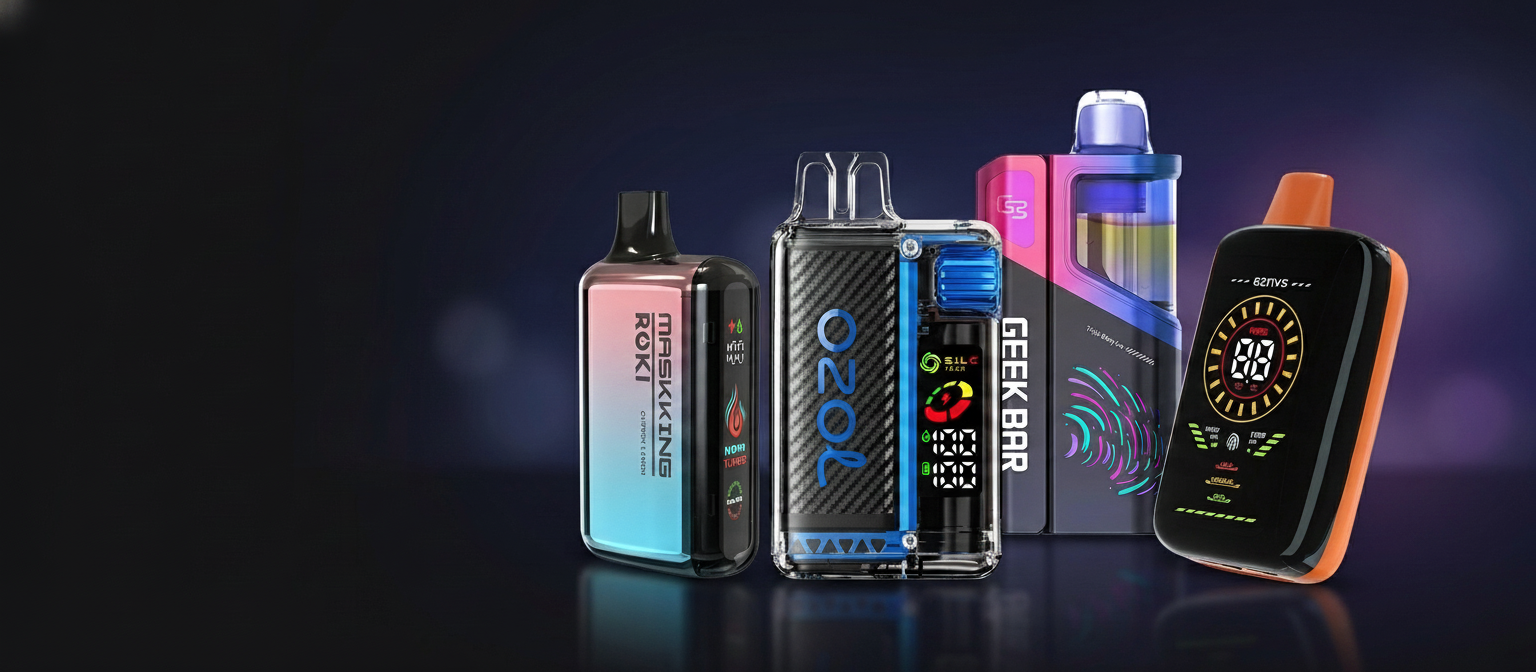
A distributor in Rotterdam sent us a spreadsheet in March that he could not make add up. Two pallet slots, same carton count. On the left, 4-in-1 units rated at 80,000 puffs. On the right, 8-in-1 units rated at 160,000. The 8-in-1 cost him 62 percent more per piece, and on the face of it that looked like money well spent, because the box promised double the flavours and double the headline number. Then he totalled the e-liquid. The 4-in-1 held 72 ML. The 8-in-1 held 60 ML. He had paid more money for less liquid. The only reason he caught it was that he bothered to divide one column by another.
We see that spreadsheet a lot now. The multi flavor disposable vape format went from a trade-show curiosity to a real slice of wholesale volume in under two years. Most of the buying behind it still happens on the puff number printed on the front of the box. That number is the least useful figure on the entire spec sheet. Below is the arithmetic we walk buyers through, built from ten units sitting in our own catalogue right now.

How a multi-tank device is actually built
Pull a normal disposable apart and you get one tank, one coil, one wick, one battery. Simple, and cheap to make.
A multi-tank unit keeps the single battery and the single outer shell. It splits the wet side into two, four, six or eight independent chambers. Each chamber carries its own coil and its own wick. The mouthpiece rotates or slides, and its position decides which chamber the airflow path connects to. Nothing else about the device changes when you switch.
That separation is the whole idea, and it exists because of a specific failure. The early attempts at this format ran several flavours over one shared wick. By the third or fourth chamber, everything tasted like the same flat candy. Separate coils kill the bleed. The Waspe 8 in 1 Crystal 180K runs quad mesh across eight chambers for exactly that reason, and the Airmez units put a 1.0 ohm mesh behind every tank rather than sharing one.
Power and control stay centralised. One cell, one charge port, and usually one display that reports the live flavour alongside battery and liquid level. Resistances stay conservative on purpose: 1.0 ohm and 1.1 ohm mesh show up across the Stag Bar line, because a coil that runs hot would cook the liquid in chambers the customer is not using yet.
Manufacturers learned that the hard way. The first 4-in-1 batches in 2024 came back with unused tanks that had gone dark and bitter long before the rest of the device was finished.
What does vary enormously is the engineering budget behind it. The Stag Bar 6 in 1 puts a 1000 mAh cell behind six tanks holding 108 ML in total. The Fycos Fycosin 30K runs a single 30 ML tank off 550 mAh. Both appear under the same category heading on a supplier sheet. They are not comparable products.
The arithmetic nobody prints on the box
Here is the same catalogue read by liquid instead of by marketing number. Every figure comes off our own spec sheets, and the right-hand column is simple division.
| Model | Tanks | Rated puffs | Total e-liquid | ML per tank | ML per 1,000 rated puffs |
|---|---|---|---|---|---|
| Waspe 3 in 1 60000 | 3 | 60,000 | 54 ML | 18.0 | 0.90 |
| Waspe 4 in 1 100000 | 4 | 100,000 | 56 ML | 14.0 | 0.56 |
| Waspe 8 in 1 Crystal 180K | 8 | 180,000 | 68 ML | 8.5 | 0.38 |
| Stag Bar Gemini 30000 | 1 | 30,000 | 30 ML | 30.0 | 1.00 |
| Stag Bar 4 in 1 | 4 | 80,000 | 72 ML | 18.0 | 0.90 |
| Stag Bar 6 in 1 | 6 | 180,000 | 108 ML | 18.0 | 0.60 |
| Airmez 8 in 1 | 8 | 160,000 | 60 ML | 7.5 | 0.38 |
| Airmez FOX 6 in 1 | 6 | 140,000 | 45 ML | 7.5 | 0.32 |
| Fycos 100K 4 in 1 | 4 | 100,000 | 60 ML | 15.0 | 0.60 |
| Fycos Fycosin 30K | 1 | 30,000 | 30 ML | 30.0 | 1.00 |
Two lines deserve a second look. The Waspe 8 in 1 Crystal and the Stag Bar 6 in 1 both claim 180,000 puffs on the box. One carries 68 ML. The other carries 108 ML. Identical headline, and 59 percent more liquid inside one of them.
Go the other way and it gets stranger. The Airmez 8 in 1 has twice the tank count of the Stag Bar 4 in 1. It still holds 12 ML less. Eight sounds bigger than four. In liquid, it is not.
That last column is the one we actually use when costing a line out. It runs from 0.32 ML per thousand rated puffs on the Airmez FOX 6 in 1, up to 1.00 on the single-tank units. A threefold spread across ten products from four brands. Each factory picked its own test method. The number on the box says more about the marketing department than the hardware.

Why the puff figure is not a consumption figure
Rated puff counts come off a bench machine. It takes a short draw of fixed duration at a fixed interval, and it counts until the tank runs dry. A person does not vape like a bench machine. Real draws run longer. They come in clusters, and they vary by customer, by mood and by the weather.
So the honest conversion from box number to real usage sits somewhere between a third and a half. We are not going to pretend that is a precise factor. There is no standard test, so there cannot be a standard conversion. The direction is reliable, though, and it explains what buyers keep reporting from their counters. A shopper who finishes a 30,000-puff single tank in ten days will not get six times the life out of a 180,000-puff unit. Three times, maybe four. Not six.
Liquid volume does not have that problem. Millilitres are millilitres, measured the same way in every factory. If you need one number to compare two units across two brands, use the tank and ignore the box.
What eight tanks cost you elsewhere
More chambers means more than a bigger number on the shelf. It means a set of trade-offs that show up after the sale.
- Size and weight. Six tanks holding 108 ML is a genuinely large object. Fine in a bag, awkward in a shirt pocket.
- More coils. Eight coils is eight potential failure points, and also eight pieces of redundancy. One dead chamber does not brick the other seven. That is a real advantage over a single-tank unit, where one burnt coil ends the product.
- Cash on the shelf. A higher unit cost sits in your stockroom until it sells. At 62 percent more per piece, a slow-moving carton hurts twice as much.
- Flavour fatigue. Buyers love the idea of eight choices. Customers use three and forget the rest. The unused capacity is paid for either way.
- Explanation time. Every one of these needs a sentence of counter explanation. Without it, the screen and the rotating mouthpiece are decoration.
None of that argues against the format. It argues for pricing it properly and briefing the people selling it.
Where the multi flavor disposable vape format earns its shelf space
Three situations keep appearing in our order data, and they have very little to do with puff counts.
Travel and long shifts. Truck drivers, festival weekends, resort towns, night shifts. Anyone who cannot recharge or restock for two days, and does not want to carry three separate devices. This is the strongest use case in the category. It is also the one that produces repeat buyers.
High-turnover tourist counters. A shop that sees a customer once and never again sells variety far better than it sells loyalty. Eight flavours in one body reads as value at the counter in a way a spec sheet never will. Nobody on holiday wants a deep conversation about coil resistance.
SKU consolidation, which buyers consistently underestimate. Six flavours as six stock lines means six things to count, six slow movers, six entries in your reorder sheet. One 6-in-1 unit collapses all of it into a single line item. For a small shop with limited shelf depth, that consolidation is worth more than any puff rating.

Where it does not
Keep the format to a couple of facings if your regulars already know what they like. Someone who buys the same mango device every week is not paying a premium for seven flavours they will never touch. Pushing them towards it costs you a sale rather than adding one.
The same applies in price-led markets where the conversation starts and ends at the sticker. A 180,000-puff unit at three times the price of a 20,000-puff unit loses that conversation regardless of what is inside it. The comparison in the customer’s head is per-piece, not per-millilitre.
High staff turnover is the third one. If nobody behind the counter can explain the device in one sentence, it becomes an expensive paperweight with a display on it. We have watched this happen in shops that otherwise run tight operations.
Six questions to ask before you place the order
- Total e-liquid in millilitres. Not the puff number, the volume.
- How many coils, and is there one per tank?
- Battery capacity and charge port. Type-C is standard now. 550 mAh behind 108 ML of liquid is not enough.
- Which nicotine strengths exist for your market. Most of these lines ship in 0, 2 and 5 percent, but not every model comes in every strength.
- Carton structure. Can you order mixed-flavour cartons, or are you committing to one flavour per carton?
- What happens when one chamber runs dry or a coil dies early. Does the rest of the device keep working?
Get those answers in writing before the deposit goes out. Any supplier who can only quote you a puff count has not read their own product sheet. That tells you how the rest of the order will go.
How we list ours
We put total liquid volume on every multi-tank listing alongside coil count, coil resistance, battery capacity and the available strengths. Without the volume figure, a buyer cannot do any of the arithmetic above. The Waspe makes the point neatly: three models at 54, 56 and 68 ML, where the puff ratings climb far faster than the liquid does.
Two older pieces are worth ten minutes if you are weighing an order. We took a Vapsolo apart and measured what a multi-flavour unit delivers across its full life. There is also a separate write-up on where dual mesh coils fit into the push towards higher puff numbers. Both were written before this generation of six and eight tank units arrived. That gap is itself a reminder of how fast the format has moved.
If you are costing out a multi-tank order and want the liquid figures for a model not listed here, send the model name over. We would rather run the division with you than let you find the 68 versus 108 problem after the container lands.